

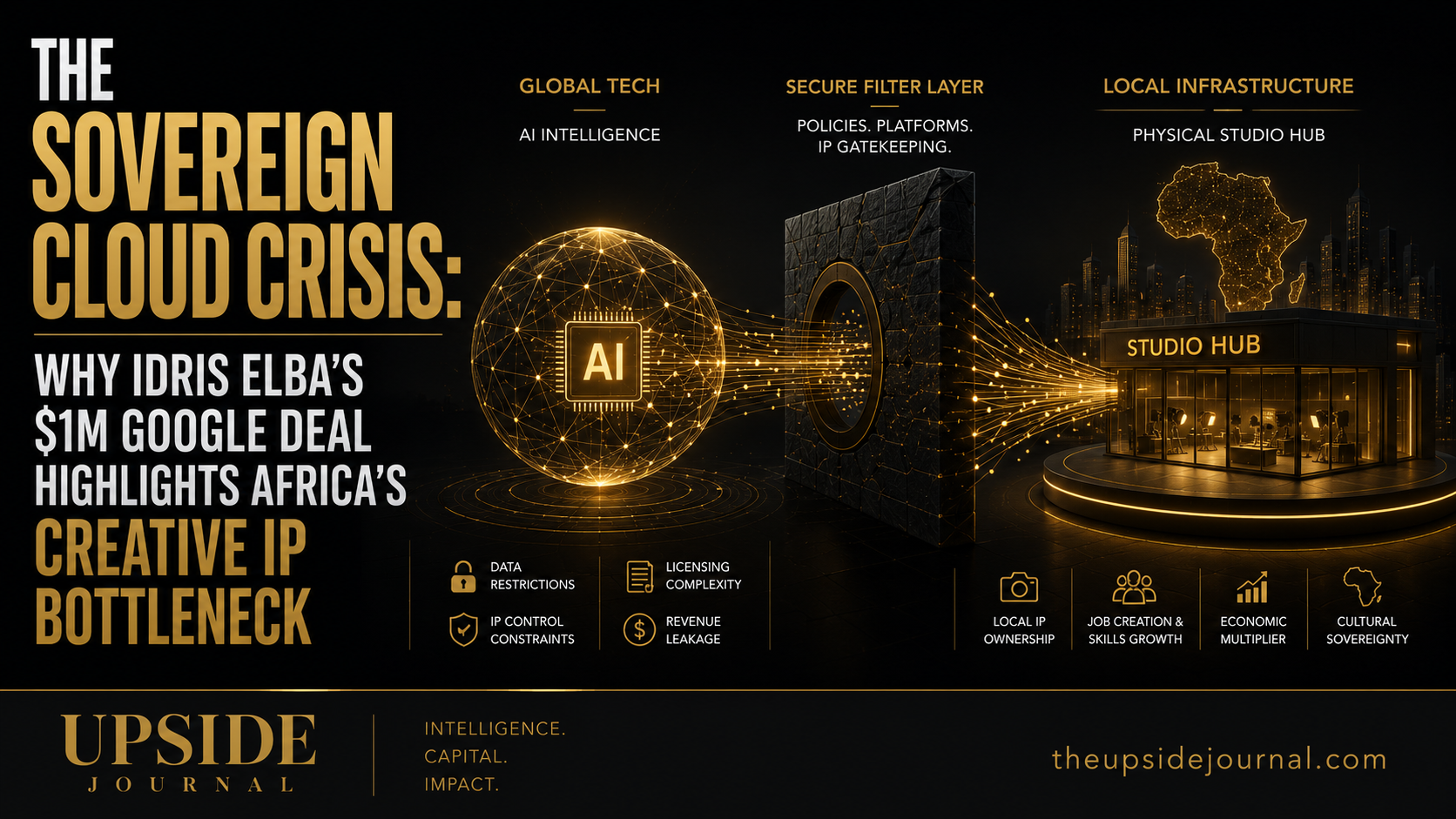
The Sovereign Cloud Crisis: Why Idris Elba’s $1M Google Deal Highlights Africa’s Creative IP Bottleneck
Beyond the Software: How the Idris Elba Google Partnership Explores Africa’s Tech Infrastructure Gap

The partnership between Idris Elba and Google, announced at the Google Africa Cloud Summit in Johannesburg, is far more than a philanthropic gesture or celebrity endorsement. It is a macro-story that perfectly bridges international tech capital, celebrity culture, and the systemic structural shifts reshaping Africa's creative economy in 2026.
Through a $1 million initiative, Google and Elba's Elba Hope Foundation are providing free access to Gemini AI and other digital tools to approximately 100,000 creators across Nigeria, South Africa, Ghana, Kenya, and Sierra Leone. The goal is to lower production costs, accelerate content creation, and help African storytellers compete on the global stage.
For context on how this fits into the broader diaspora capital flywheel reshaping African tech in 2026, see our deep-dive on Africa's AI talent diaspora flywheel: remittance-to-VC and startup acceleration.
The Under-Reported Economic Reality: Creative Sovereignty and Localised Compute
Mainstream coverage frames the deal as a "budget workaround" or corporate talent grab by YouTube and Google. The deeper story is creative sovereignty and the localised compute bottleneck.
When a Nigerian filmmaker or Ghanaian musician uses Gemini to generate scripts, storyboards, or music, that data and processing often flows through data centres governed outside the continent. This creates dependency risks around data control, IP ownership, and compliance with emerging African data protection laws — including Nigeria's NDPR and Ghana's Data Protection Act, both increasingly aligned with the regulatory direction set by the EU AI Act's 2026 enforcement framework.
The State of Nigeria's Creative Economy 2026 report repeatedly highlights unreliable power and poor internet infrastructure as bigger hurdles than software access itself. Sovereign cloud and edge computing solutions are not luxuries — they are foundational for sustainable creative industries.
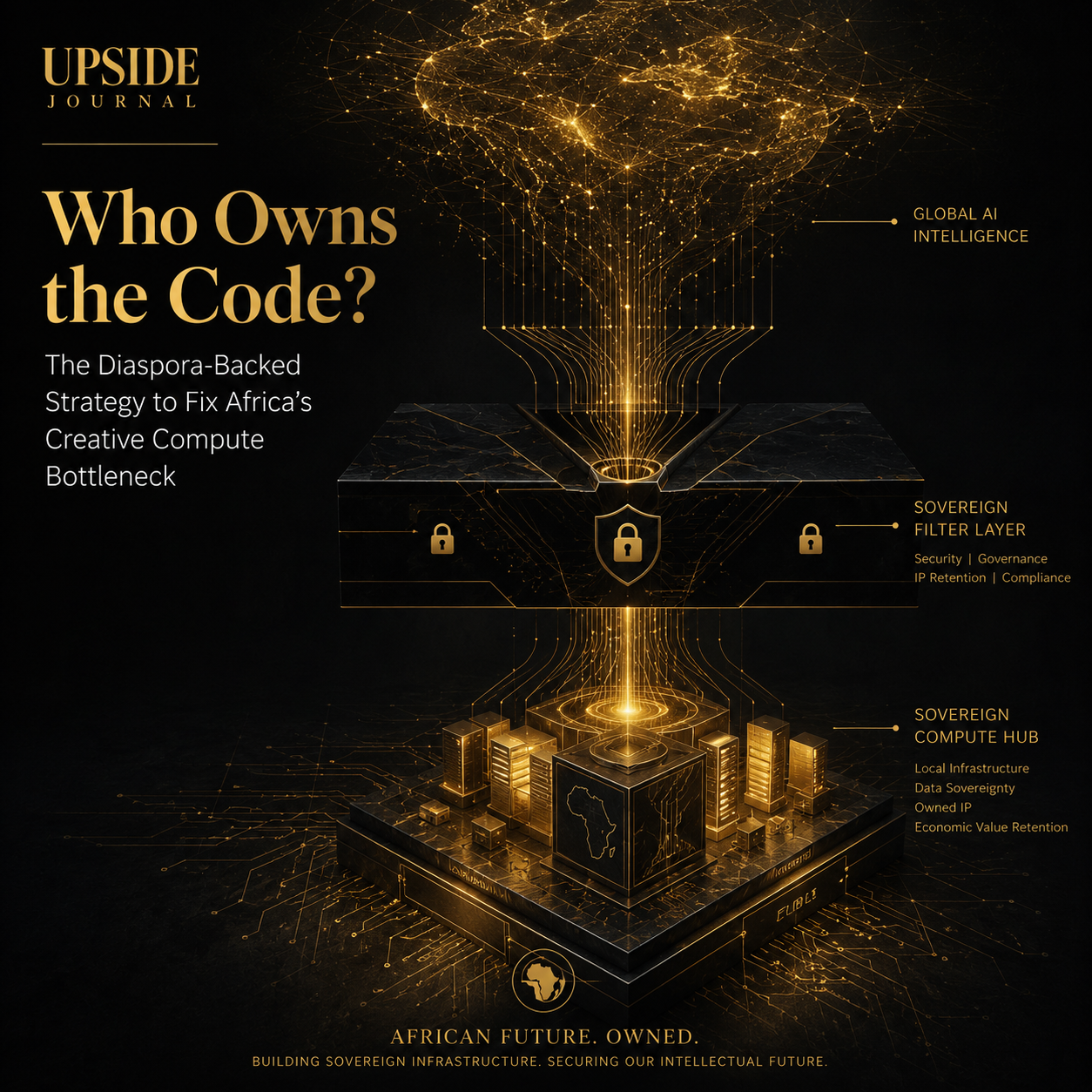
Elba's involvement adds a powerful diaspora dimension. His work through the Elba Hope Foundation and Akuna Group emphasises building physical infrastructure — studios, training facilities — alongside digital tools. This hybrid approach, global AI access paired with local compute and IP ownership, represents a sophisticated model for African creative economies. It is precisely the kind of human-plus-infrastructure thinking we outlined in the diaspora operator's guide to agentic AI.
Diaspora Repatriation and the Fintech-to-Investment Flywheel
Elba exemplifies a growing trend: high-profile diaspora figures moving beyond passive remittances to direct investment and ecosystem building. A prime example of this operational shift is Elba's Akuna Wallet, which recently entered the Bank of Ghana Regulatory Sandbox to pilot cross-border creative financing rails.
African remittances continue to dwarf official development aid, but the 2026 evolution is clear — talent and capital are being channelled directly into productive financial and creative assets. For a granular breakdown of how this flywheel is accelerating across the continent, read our creator economy metrics 2026 report on the emerging African middle class.
The African creative economy already contributes significantly to GDP — nearly 4% in sub-Saharan Africa in recent estimates, generating tens of billions of pounds in economic value annually. AI tools can accelerate this trajectory, but only if paired with sovereign infrastructure to retain value locally.
Google's initiative provides immediate access, but long-term success depends on African-owned data centres, local language models, and IP frameworks that prevent value leakage. Partnerships like this can catalyse both — bringing tools today while building capacity for tomorrow.
Regulatory and Infrastructure Context in 2026
Africa's AI and creative sectors are maturing amid a global push for digital sovereignty. Initiatives such as the AI Hub for Sustainable Development, national data strategies in Rwanda, Kenya, and Nigeria, and pan-African cloud projects like AfriCloud are gaining significant momentum.
For creators, the combination of Gemini access and local compute investments could dramatically lower barriers. A filmmaker in Accra could generate high-quality storyboards with AI, render locally on sovereign infrastructure, and distribute globally — retaining substantially more economic value in the process.
Challenges remain: energy reliability, last-mile connectivity, and skills gaps. Elba's physical infrastructure plays, including his proposed major studio developments in Zanzibar and Ghana, address these holistically by anchoring digital tools in physical brick-and-mortar operations — a model consistent with the sovereign-and-edge AI deployment frameworks we mapped in agentic AI in enterprise stacks 2026.
The Nigerian fintech regulatory environment provides a useful parallel. As we reported in our analysis of Nigeria's fintech sandbox and the July 2026 CBN roundtable, the tension between regulatory pace and infrastructure ambition is a defining feature of Africa's digital economy this year — and the creative sector faces the same structural constraints.
Deal Flow Implications for Brands, Investors, and Operators
This announcement signals maturing opportunities at Africa's creative-tech intersection:
- Brands: Authentic partnerships with diaspora-led creators deliver higher engagement in African and global diaspora markets than traditional media buys. As we documented in the sponsorship money trail behind African and diaspora brands at the 2026 World Cup, diaspora-anchored brand strategies are producing measurably superior ROI.
- Investors: The remittance-to-VC flywheel is accelerating. Diaspora angel networks and micro-funds are de-risking early-stage creative AI plays. The 2026 AI agent roll-up wave is already drawing consolidation capital toward African infrastructure targets.
- Operators: Hybrid operational models — global tools plus local sovereignty — offer highly defensible regional moats. The 10-year case for AI-native media companies articulates precisely why first-mover sovereign infrastructure positions compound over time.
Expect more deals blending celebrity capital, big tech tools, and local infrastructure across Africa in H2 2026.
The Broader Structural Shift
The Elba-Google partnership is a microcosm of Africa's 2026 creative economy evolution: from consumer of global tech to co-creator with strategic sovereignty. By addressing both immediate tool access and long-term infrastructure and IP bottlenecks, it models the balanced approach needed for sustainable growth.
For the African diaspora in the UK and across Europe, this reinforces a powerful narrative — economic repatriation through talent, capital, and cultural influence. For global enterprises, it highlights Africa not just as a market but as a strategic innovation partner.
The beautiful game of creative sovereignty is just beginning. Those who understand the full money-and-infrastructure trail will capture outsized value in the years ahead.
What's your view on the balance between global AI tools and local creative sovereignty?Share your thoughts on LinkedIn or X, or join our premium membership for deeper deal flow intelligence, operator playbooks, and diaspora investment networks.
Intelligent. Cultural. Global. Human."Where the world's conversations become movements."