


Operational Leadership in the AI Era: What Great Leaders Do Differently
operational leadership, leadership in operations, operational leadership model, operational leadership principles.
There is a version of operational leadership that made sense in 2019.
You set the strategy. You built the team. You designed the process. You measured the output. You iterated. You hired better. You repeated.
That version still exists. But it is no longer sufficient.
In 2026, the organisations pulling ahead are not those with the most disciplined processes. They are those with the most intelligent ones. And the leaders running those organisations have added something to the traditional playbook that most leadership literature has not yet caught up with: they know how to lead humans and AI agents simultaneously, in the same operational system, toward the same outcome.
This is the new frontier of operational leadership. And the gap between those who understand it and those who don’t is widening faster than most executive teams are willing to admit.
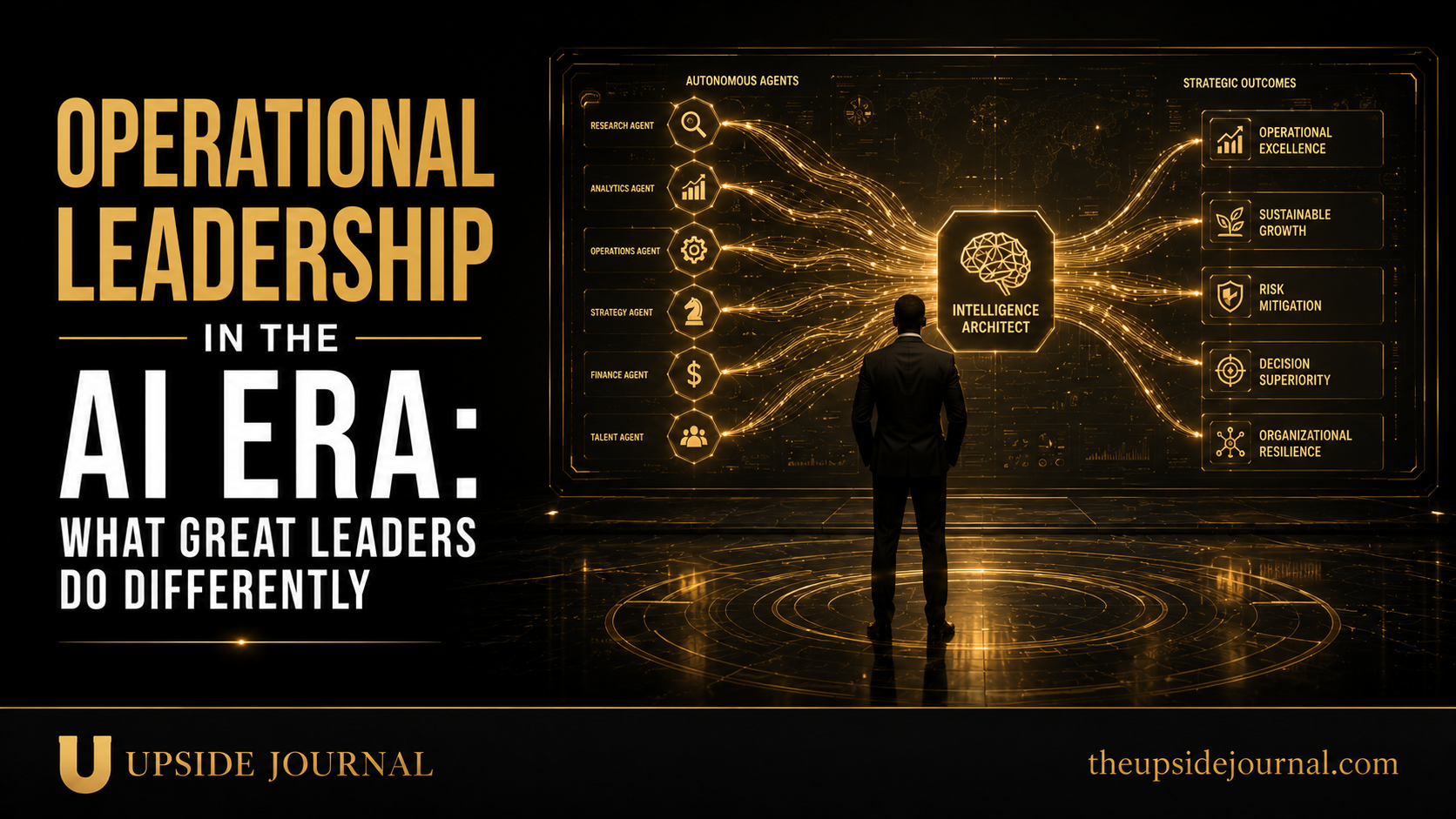
The Shift: From Process Manager to Intelligence Architect
Ask most senior operators to define their role and they will use words like execution, accountability, throughput, efficiency. These are the right words. They were the right words in 2015 and they remain the right words today.
What has changed is the system those words describe.
In a traditional operational model, the leader’s job is to design a process that human beings can execute reliably and improve over time. The bottlenecks are human. The errors are human. The optimisation levers are people, tools, training, and incentives.
In an AI-integrated operational model, the system includes autonomous agents executing tasks, making decisions, and generating outputs that the leader never personally reviews. The bottlenecks are architectural. The errors are systemic. The optimisation levers include governance layers, data pipelines, agent orchestration, and the quality of the human judgement sitting at the edges of automated workflows.
For a deeper look at the infrastructure underpinning these autonomous systems, see our breakdown of agentic AI in enterprise stacks 2026.
Great operational leaders in 2026 are not replacing their process-management skills. They are layering intelligence architecture on top of them.
That means asking different questions:
- Not just: Is the team hitting the target? But: Which parts of this workflow should a human own, which parts should an agent own, and where are the handoff points that require human oversight?
- Not just: Where are we losing time? But: Where is our data governance preventing the agents from acting on good information?
- Not just: How do we scale the team? But: How do we scale the system — and what does the human layer need to look like when it does?
The Five Operational Leadership Principles That Still Hold
Before getting to what is new, it is worth being precise about what hasn’t changed. The fundamentals of leadership in operations are not being replaced by AI. They are being stress-tested by it — and the leaders who have internalised these principles are the ones navigating the transition most effectively.
1. Clarity of outcome precedes clarity of process
The most common failure in operational leadership — in 2016 and in 2026 — is teams that are extremely busy executing a process that no longer connects to the right outcome. AI makes this worse, not better. Autonomous agents executing the wrong workflow at scale produce wrong outcomes faster than humans doing the same thing. Great operational leaders obsess over outcome definition before they design the process or select the tool.
2. What gets measured gets managed — but only if you measure the right things
Measurement cultures are vulnerable to a specific trap in the AI era: optimising for metrics that agents can easily report rather than outcomes that actually matter. Leaders who define meaningful KPIs before deploying AI systems — rather than letting the system surface whatever is easy to count — maintain strategic control of the operation.
3. Trust is built through transparency, not authority
In a human-agent team, trust is also built through explainability — the ability to show every stakeholder, internal and external, how and why a decision was made, whether by a human or a machine. Leaders who build transparency into their operational systems by design will earn more trust from their teams, their boards, and their customers than those who treat AI as a black box.
This principle connects directly to the governance frameworks we outlined in why agentic AI hype will under-deliver for most enterprises in late 2026.
4. Pace of learning beats pace of execution
Organisations that iterate intelligently outperform those that simply execute quickly. The leaders winning in 2026 are running tight feedback loops — deploying agents in limited, measurable contexts, extracting learning, adjusting the system, and redeploying. They treat every autonomous workflow as a live experiment, not a permanent fixture.
5. The leader’s highest-value work is the work only a human can do
Great operational leaders in the AI era are ruthless about protecting their time for the decisions that require human judgement, relationship intelligence, contextual nuance, and ethical accountability. They delegate everything that can be systematised — including to agents — so that their human capacity is concentrated on the 20% of decisions that determine 80% of outcomes.
The New Operational Leadership Model: Human + Agent Teams
The most consequential practical shift in leadership in operations right now is the move from managing human teams to orchestrating human-agent teams.
This is not a future scenario. It is the operating reality of every forward-looking organisation that has moved beyond AI pilots into production.
Consider a growth operation. In a traditional model, a team of analysts, marketers, and operations managers handles campaign execution, reporting, customer segmentation, and performance review. In a human-agent model, agents handle campaign execution, real-time reporting, segmentation updates, and anomaly flagging. Human team members handle strategy, creative direction, exception management, stakeholder communication, and the decisions where context and judgement matter.
The operational leadership model required to manage this demands leaders who can:
- Define clear boundaries between human and agent responsibility within a single workflow
- Design escalation paths that ensure human judgement is applied at the right moments
- Build governance structures that maintain accountability when output is generated autonomously
- Develop their teams’ ability to work alongside agents, rather than fear replacement by them
- Communicate system behaviour to non-technical stakeholders without losing their trust
For operators building cross-continent teams within this model, our diaspora operator’s guide to agentic AI provides a complementary framework for the talent and governance dimensions.
These are operational leadership principles for an era that most leadership curricula have not yet fully addressed.
What Great Leaders Do That Average Leaders Don’t
They treat governance as a strategic asset, not a compliance cost
Average leaders see governance as the thing that slows things down. Great leaders see it as the foundation that allows them to move fast with confidence. In an AI-integrated operation, this distinction is existential. The leaders who have invested in governance infrastructure — audit trails, explainability layers, human oversight protocols — are the ones who can scale autonomous workflows without the systemic failures that erode trust and trigger regulatory scrutiny.
The 2026 AI agent roll-up wave is already rewarding organisations with mature governance infrastructure at a premium valuation.
They invest in their team’s AI literacy before they invest in AI tools
The pattern of deploying technology ahead of team capability is one of the oldest and most persistent mistakes in operational management. In the AI era, it produces a specific failure mode: agents doing work that the human team cannot evaluate, question, or improve. Great operational leaders sequence deliberately — building organisational understanding of how AI systems work before expanding what those systems are asked to do.
They hold the long view on talent
The most sophisticated operators are not asking which roles AI will replace. They are asking what their human team needs to be excellent at in a world where AI handles execution at scale. The answer, consistently, is judgement, relationship intelligence, creative problem-solving, and ethical accountability.
This talent calculus is explored in depth in our analysis of the creator economy eating enterprise media — where the same premium-on-human-judgement dynamic is reshaping an entire industry.
They run the organisation at two speeds simultaneously
They maintain the disciplined, process-oriented execution culture that delivers near-term results while also managing a parallel track of AI integration, experimentation, and capability building that positions the organisation for compounding advantage. Running both without letting either crowd out the other is genuinely difficult. The leaders who do it consistently are operating at a level that most management frameworks don’t have good language for yet.
The Diaspora Operator Advantage
There is a dimension of the operational leadership conversation in 2026 that mainstream business media consistently underweights: the structural advantage that operators who grew up navigating multiple systems, cultures, and contexts bring to exactly this kind of transition.
The African diaspora operator — running businesses across London, Lagos, and Washington, managing teams spread across time zones and regulatory environments, fluent in both the institutional language of Western capital markets and the operational realities of emerging economies — has been practising human-agent team management for years.
This is not coincidental. As we documented in our analysis of Africa’s AI talent diaspora flywheel, the structural conditions that produce great diaspora operators — distributed teams, heterogeneous regulatory environments, high-context cultural navigation — are precisely the conditions that the new operational leadership model demands at scale.
The AI era is not creating new requirements for this kind of leader. It is finally giving them the tools to scale what they have always known how to do.

Your 90-Day Operational Leadership Reset
For operators who want to move from awareness to action, the following 90-day framework provides a structured starting point.
Days 1–30: Map your operational reality
Audit your current workflows. For each major operational process, identify what is currently human-executed, what is tool-assisted, and what is fully automated. Map the decision points within each process. Note where human judgement is applied and where it could be more deliberately positioned. Identify the workflows generating the most friction, the most error, or the most coordination overhead.
Days 31–60: Design one intelligent workflow
Select a single high-volume, well-defined operational process to redesign as a human-agent workflow. Define the outcome clearly. Define agent responsibilities and human responsibilities explicitly. Build in an escalation path for exceptions. Identify the governance and observability requirements. Run the redesigned workflow in a limited, measurable context and track results against a defined baseline.
For a practical infrastructure checklist to support this phase, refer to our agentic AI enterprise stacks playbook.
Days 61–90: Extract the learning and expand the model
Review the outcomes of your pilot. What worked? What did the agent handle well? Where did human judgement add disproportionate value? Where did the governance requirements surface that you hadn’t anticipated? Document the pattern. Brief your leadership team on what you’ve learned. Identify the next two or three workflows where the model applies.
At the end of 90 days, you will have hands-on operational experience with a human-agent model, a governance pattern you’ve tested in practice, and a team that has started to develop the muscle memory for working within this new operational paradigm.
That is the foundation of operational leadership in the AI era.